
Why we built OctaFuse: consolidate scattered token resources
Published
OctaFuse started with a simple problem: AI resources kept multiplying while the way we used them became more fragmented.
Coding plans, token plans, official APIs, compatible endpoints, and self-hosted models each brought a Base URL, key, quota, and price. Every new client or product duplicated connection and switching logic.
We needed more than another forwarding proxy. We needed an entrypoint we could operate ourselves.
Two original use cases
Section titled “Two original use cases”Individual developers can consolidate subscriptions and Providers behind one Gateway URL and user key for editors, CLIs, scripts, and agents. Rotating an upstream credential or changing a route no longer requires updating every client.
Teams and AI products also need user-key issuance, budgets, billing, audit, and automatic failover. OctaFuse keeps those shared concerns in the gateway so business applications do not build another credential store and charging system.
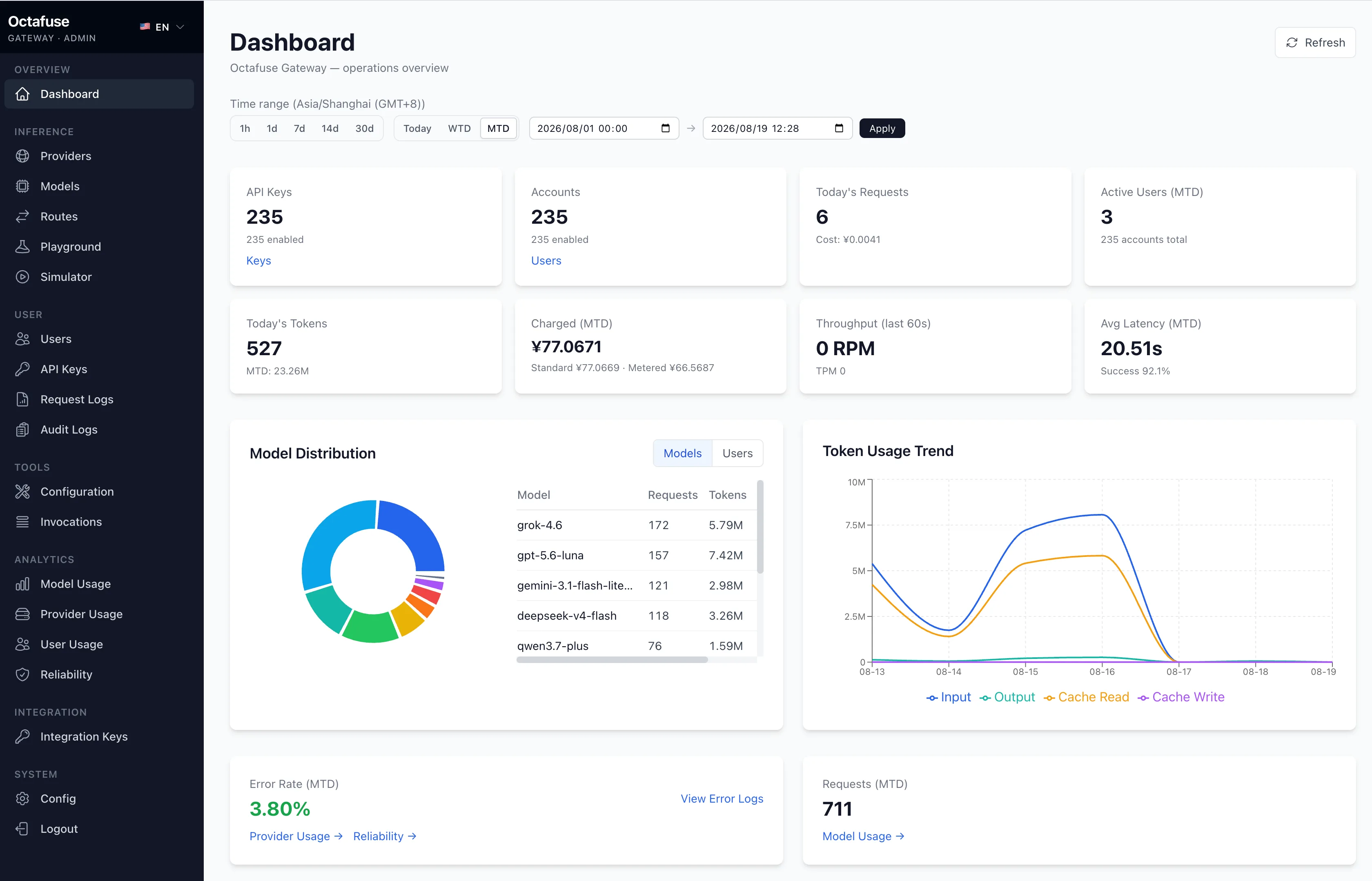
Open, self-hostable, and operational
Section titled “Open, self-hostable, and operational”OctaFuse aims to preserve three qualities:
- Open integration: official Providers, aggregators, compatible endpoints, and self-hosted services can all be represented.
- Self-hosting: deploy on Cloudflare Workers + D1 or Docker with PostgreSQL / MySQL.
- Complete governance: routing, failover, user keys, budgets, billing, logs, and audit live beside request forwarding.
Clients see a stable Gateway URL, user key, and model ID. Operators can change the Provider, account, price, or fallback chain behind that contract.
OctaFuse began by consolidating model tokens. It now extends the same operating model to images, speech transcription, and Agent Tools—moving toward a self-hosted control plane for AI capabilities.
If OctaFuse is useful to your project, consider giving the repository a Star. Your interest and feedback help this open-source project keep growing.